Image Credit: Eli Sheiner
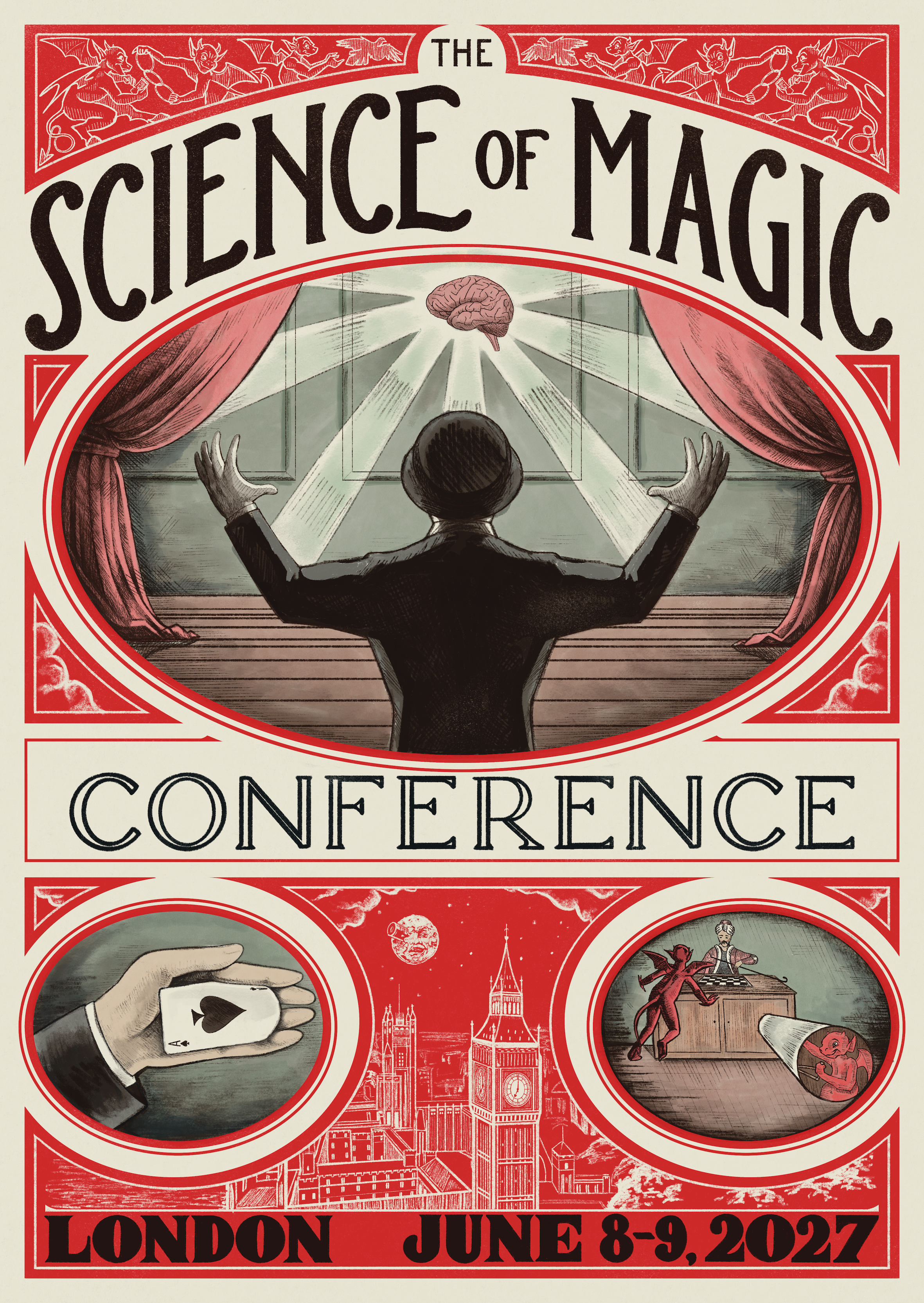
Our next conference will be taking place June 8-9, 2027
at The Magic Circle in London!
(More details & a call for talk proposals will be coming soon)

Image Credit: Eli Sheiner
Our next conference will be taking place June 8-9, 2027
at The Magic Circle in London!
(More details & a call for talk proposals will be coming soon)
The Science of Magic Association (SOMA) promotes rigorous research directed toward understanding the nature, function, and underlying mechanisms of magic.
SOMA provides a platform for discussion and dissemination of research and ideas on magic.
SOMA is an inclusive organization that welcomes members with diverse backgrounds including science and technology, humanities, practicing magicians, and individuals who are simply interested in science and magic.
We are proud to have been partnered with Fédération Internationale des Sociétés Magiques (FISM) and sponsored by Magicana and Abracademy

Interest in magic methods can be traced back throughout recorded history, but in the past 20 years, the Science of Magic has recently been undergoing a renaissance.

The Westcar Papyrus dates to around the 18th Century BCE and seems to tell the story of a magician performing 'miracles' in the court of the Egyptian pharaoh Khufu. While the story is probably best considered as a fairy tale rather than a historical account, it nonetheless shows that the idea of performing miraculous tricks for audiences dates back to some of the world's earliest written records.
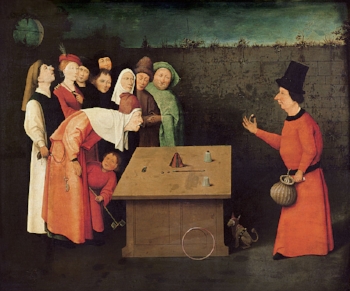
Classic Misdirection depicted in Heironymus Bosch's 'The Conjurer"
Since the year 2000, the body of experimental scientific literature on the topic of performance magic has continued to rise dramatically. To date, 109 empirical papers have been published on the topic of adult perceptions of magic tricks within the last 20 years, compared to the 12 that were published in the preceding century, between 1887 and 1999. The idea of investigating the psychology of magic is not new (indeed it arguably dates back to the earliest days of experimental psychology), but this recent level of interest is historically unprecedented.

You can also sign-up to our newsletter to receive a free bibliography listing every published empirical study of adult perceptions of magic tricks between 1887-2024.
Art by Kyla Moffatt (www.kylamoffatt.com)
We are delighted to announce that the 5th SoMA international conference will be taking place June 8-9, 2027 in London, UK. The event will take place at The Magic Circle, bringing together academics, researchers, and magicians from around the world and featuring top keynote speakers, presentations on recent research, a poster session, and a gala show.
We welcome presentations from across disciplines that are themed around rigorous research or theory directed toward understanding the nature, function, and underlying mechanisms of magic and illusion. We also invite submissions from practitioners who have applied principles of theatrical magic in unique settings. SoMA is an inclusive organization that welcomes members with diverse backgrounds and across multiple disciplines including science and technology, humanities, practicing magicians, and individuals who are simply interested in science and magic.
We’ll be announcing more details here soon, including a call for abstracts.

Art by Kyla Moffatt (www.kylamoffatt.com)
Thanks to everyone who participated in the 4th (semi) biannual SoMA international conference! The event took place on November 12-13, 2024 in Las Vegas, Nevada, at the Golden Nugget Casino. We gathered together together academics, researchers, and magicians from around the world and featured top keynote speakers, presentations on recent research, a poster session, and a gala show.
We welcomed presentations from across disciplines that were themed around rigorous research or theory directed toward understanding the nature, function, and underlying mechanisms of magic and illusion, including submissions from practitioners who have applied principles of theatrical magic in unique settings. SoMA is an inclusive organization that welcomes members with diverse backgrounds and across multiple disciplines including science and technology, humanities, practicing magicians, and individuals who are simply interested in science and magic.
Invited speakers included:
Teller will be attending (and, perhaps ironically, speaking) as this year’s Guest of Honor
Prof. Thalia Goldstein: Director of Applied Developmental Psychology at George Mason University
Carisa Hendrix: Multi-award winning comedy entertainer and magician
+ A Special Symposium with Jeff McBride and the Magic & Mystery School.

Thanks to everyone who participated in our BSA workshop: “The Art and the Aesthetics of Illusions” funded by The British Society of Aesthetics (BSA) and co-sponsored by the Science of Magic Association (SoMA).
When: The workshop will took place on Tuesday 11 July 2023
Where: The Magic Circle 12 Stephenson Way London NW1 2HD United Kingdom

Our latest conference took place at Goldsmiths University of London from 20-22 July 2022. This conference brought together academics, researchers and magicians from around the world and featured top keynote speakers, presentations on recent research, a poster session, and a gala show.
Special thanks to our Gala Show performers Laura London, Edward Hilsum, Paul Zenon, Julius Frack, and Lee Hathaway to our keynote speakers Chris French and Sophie Scott, and to our Guest of Honor Derren Brown!

In a(nother) year in which nothing was normal, and we couldn’t gather for magic conventions or academic conferences, the Science of Magic Association presented a series of free online webinars on topics at the intersection of magic, science, philosophy, and culture. Each one-hour webinar featured three or four eminent speakers and ran for approximately one hour on Zoom. Seminars included moderated discussions along with live audience Q&A sessions. Every event was recorded and you can view the recordings by clicking the button below.

Our second annual conference took place in at the Chicago Magic Lounge in the summer of 2019.
Special thanks to our Gala Show performers Mac King , Ginny and Simon Aronson, Jeanette Andrews, Mister Danny, Tom Stone, and to our keynote speakers Professor Elizabeth Loftus and Professor Dan Simons, and our Guest of Honor Simon Aronson.
Please sign-up to our newsletter to be kept up-to-date
Click Here- For information on our 2019 Summer Seminar, or our 2017 conference or our 2016 workshop
Gustav Kuhn is a cognitive psychologist interested in human perception and cognition. Much of his research focuses on magic and explores ways in which magicians allow people to experience the impossible. He is the head of the MAGIC lab at the University of Plymouth, where psychologists use magic methods to study a wide range questions about human cognition. For example, why is your mind so easily trick? How can we misdirect your attention, and why is your experience distorted by perceptual, attentional, and other more general cognitive illusions? He believes that the science of magic can provide us with valuable insights into human cognition. Much of his other research centers on social cognition, and attentional processes involved in social interactions.
Dr. Anthony Barnhart is an Associate Professor of Psychological Science at Carthage College in Kenosha, Wisconsin. He received his Ph.D. in Cognitive Science from Arizona State University. Tony is also a part-time professional magician with over 20 years of performing experience. His research trajectory changed in 2010 with the publication of the book Sleights of Mind: What the Neuroscience of Magic Reveals about our Everyday Deceptions, in which he was featured as a consultant and teacher on the science of stage magic. The scientific interest that the book garnered motivated Tony to shift his focus toward the interface of science and magic. His current research on the topic explores inattentional blindness and the techniques magicians use to manipulate attentional deployment in time. He regularly teaches a college course devoted to the cognitive science of magic.
Matt Tompkins is an experimental psychologist, professional magician, and author. He completed his DPhil at Oxford’s Department of Experimental Psychology, where his thesis focused on the historical and contemporary study of cognitive illusions. He now works for Lund University's Choice Blindness Lab on a project designing fake mind control machines. His work has featured across international media outlets including the BBC, The Washington Post, and Buzzfeed. His latest book, The Spectacle of Illusion, explores the historical relationships between scientists, magicians, and fraudulent mystics.
Alice Pailhès obtained her PhD in Psychology at Goldsmiths, University of London. She is fascinated by the quirks of our mind and passionate about transmitting scientific knowledge outside academia. Her research focuses on using magicians' forcing techniques to study illusory sense of agency and illusions of control over choice, to better understand the subtle factors that influence our decisions without our awareness. Her work has been published in journals such as Proceedings of the National Academy of Sciences, Journal of Experimental Psychology: General, or Trends in Cognitive Sciences. She makes it accessible to the general public via her public talks and interventions across diverse media outlets and events such as TED, the BBC, Victoria & Albert Museum or the Wellcome Collection.
Jason Leddington is a philosopher who works on perception, aesthetics, and philosophy of art. He is Professor of Philosophy at Bucknell University and—through 2021—a Marie Curie Fellow at the Centre for Philosophical Psychology at the University of Antwerp. His research on magic takes a multi-disciplinary approach to core questions such as: What is magic? What happens in the mind of a spectator who experiences a good magic trick? If magic involves being fooled, why are we attracted to it? As a Marie Curie Fellow, he’s working on a series of articles and a book on the philosophy of magic (under contract with The MIT Press). For more information about his work, see www.jasonleddington.net.
Brian Rappert is a Professor of Science, Technology and Public Affairs at the University of Exeter. His long term interest has been with examining the strategic management of information, particularly in relation to armed conflict. His books include Experimental Secrets, How to Look Good in a War and The Dis-eases of Secrecy. In 2017, he began learning magic; a pursuit that culminated in the book Performing Deception: Learning, Skill and the Art of Conjuring. The questions he currently addresses include: How do magicians learn to act naturally? How can they care through deception? How do students of magic learn about the limits of perception, memory and cognition through their perception, memory and cognition?